Tofino storm watching season
Tofino storm watching season
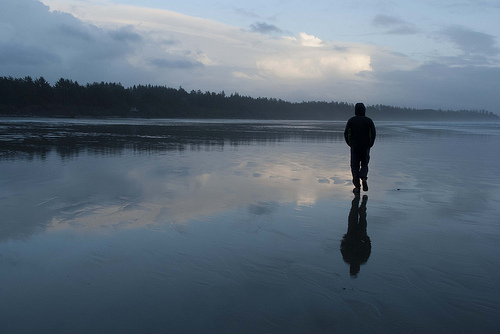
Long Beach, Tofino
The middle-aged blond guy sitting next to me smells like stale cigarettes and sour beer. He’s wearing faded jeans, a flannel shirt and three days’ worth of stubble. It’s ten past eight in the morning. It looks like he’s going to have a rough day.
The student on my other side is sleeping, his backpack clutched in his arms. He is jostled awake as the bus comes to a sudden stop, the driver curses, and we all take in a sharp breath. Everyone is cranky today – people yell at no one in particular: “Move down! There’s plenty of space back there!”
A young woman standing in front of us clutches her coffee; she has a slightly pinched look on her face. It’s possible that her skin-tight synthetic grey business pants are cutting off circulation to a critical artery somewhere beneath her wrinkled shirt. She stares straight through the passengers seated in front of her, who are also starring straight ahead. We all avoid eye contact. There are probably 30 of us crammed into this section of the bus alone.
Then the door refuses to shut because there are too many people crammed in the doorway; the speakers repeat their sinister warning chime as we all crane our necks to see what’s holding us up.
“Get off the bus! There’s not enough room!”
“I’ve had three buses pass me already! I’m going to be late!”
Finally someone takes off their shoulder bag to create an extra 10 inches of space, and by a small miracle everyone shuffles slightly to the left and the door finally closes. Then, just when I think my morning commute couldn’t get worse… someone farts.
Welcome to the 99.
The 99 B-line is an express bus that runs the 12 km route down the Broadway corridor from Commercial Driveto the University of British Columbia. During the morning rush hour, a full bus leaves Commercial Drive every two to three minutes. At its peak, the 99 will carry up to 2,100 passengers per hour.
It’s not like this all the time. By far September is the cruelest month – the onslaught of fresh UBC students is a sharp contrast to the relatively spacious and carefree summer. Comparatively, from May until August the 99 is a blissful caravan filled with light, laughter and liberty. Cigarette girls wander up and down the aisle with free refreshments. Stewarts offer fluffy pillows for you to rest your sleepy head. Troubadours play music and make merry. Everyone smells great.
At least that’s how I remember summer compared to the lunacy of September, when every face wears a grimace and I am often perturbed by the unnatural intimacy of strangers’ proximity – here a thigh pressing against my own, there a crotch staring directly into my eyes. I once had a passenger straddle my leg as he tried to make room for people shoving past to get to the door. I could feel his balls against my knee. That was a bit much. True, there are some mornings when the warmth of another human being has been strangely comforting. It depends on my mood and who’s sitting next to me.
Besides the troubling squish of packed human flesh, the next strongest attribute of the 99 would have to be the smells. Oh, the scintillating scents of the 99! There is the intermittent flatulence, the smell of fresh Egg McMuffins, body odour, and strong coffee. Occasionally there is the halitosis of the mouth-breather sitting next to you. In winter there is also the hot, moist smell of mildew and wet pea coats.
Perhaps because of the madness, there’s a certain camaraderie amongst me and my fellow riders. For instance, there’s the Latina woman I see most mornings. We exchange smiles while we’re waiting for the bus; she always grabs a 24, one of the free daily news rags, and talks loudly in Spanish on her mobile phone. We catch the bus at the same time – it’s the last one that runs during rush hour from our stop east of Commercial Drive. For a while the bus was running really late or early, or bypassing our stop altogether, and we started to check in with each other to see if it was time to abandon ship and just walk down to Commercial to get in line and catch it there. On rare occasions we’ll also be on the same bus coming home and exchange a few words.
“Long day today!” She’ll exclaim.
“Sure was!”
“See you tomorrow!”
This summer I struck up a conversation with a woman at my stop who was also putting her bike on the front rack of the bus. We cyclists have to stick together, you know. She had an easy smile, kind blue eyes and messy, short blond hair. Our conversation started with the usual banter about how hard it can be to get your bike on if the rack is sticky, and over the course of the 45-minute ride meandered to discussing how she and her female partner had conceived their two children with a gay male friend with whom they were now in an open parenting relationship.
Otherwise, I’m not really the chatty type. More often, I’m the type of passenger who prefers to cocoon myself in a bubble of music and literature, occasionally looking up to catch a glimpse of the mountains between high rises and strip malls. Headphones on and nose in a book, I can ignore the passengers shouting to get let off and the asinine repartee of people making polite conversation.
I choose my reading materials and music carefully. As much as I like to complain about the 99, at least I can sit and read – something I couldn’t do if I was driving and stuck in traffic. I don’t have to worry about paying attention to the road, deal with bad drivers, or be alert. Some days, if I’m reading a good book or magazine article, I’m disappointed to come to the end of my ride. At the least, literature and music puts me in a time bubble in another dimension.
I know riding the bus is a pain. Ideally, I wouldn’t have to commute as far as I do and I could walk or bike both ways (for a variety of reasons ranging from sweat to laziness, I prefer to just bike home). But I much prefer it to driving. When I’m sitting on the bus and look out the window to see all the single-passenger cars going by, I can’t help but think of all the carbon emissions being spewed into the fresh ocean air Vancouverites are always going on about. In the summer, on the ferry on the way toVictoria, I’ve seen a thick dome of brown smog hovering over our beloved Stanley Park and glassy high-rises. As an asthma sufferer, I can’t help but think of what this is doing to my lungs.
Vancouver needs better public transit along the Broadway corridor. According to Translink, Metro Vancouver’s public transit provider, the 99 passes up to 2,000 people every morning. While there has been a lot of debate around prioritization for the next expansion of the Skytrain,Vancouver’s monorail service, one thing that’s for certain is that Vancouver needs to take an aggressive approach to increasing public transit capacity across Metro Vancouver. As gas prices continue to rise, as air quality declines, and as populations increase, we can’t afford not to.
So while I may have trying moments during my daily commute, I’ll choose it over driving alone in a car any day.
Plank Magazine, March 11th, 2010
Seven people are preparing to jump off the south side of the Vancouver Public Library. About 300 people have begun to gather, watching in anticipation. There are no paramedics on site, no safety nets have been deployed. Tension mounts. Children fidget and start to cry. Groups of friends huddle, clutching their daily dose of Starbucks.
Finally, the music starts and the dancers begin to saunter across the face of the library, held safely in place, mid-air, by rock climbing gear rigged to the top of the building. The dancers’ majestic movements are choreographed by Julia Taffe, artistic director and founder of Aeriosa Dance Company. Occasionally, the performers push off the building, dangling above ground and causing a collective sharp intake of breath. The gravity-defying dancers bounce gracefully off the façade, like a band of ninjas in frilly costumes.
Since its creation in 2001, thousands of Vancouverites have seen Aeriosa perform. They may have caught a show at the Scotiabank Dance Centre (at one of several events off the north or south side of the venue, in its theatre, or in its lobby), off of the Hudson House building in Gastown (during the Vancouver International Jazz Festival), at the Plaza of Nations (during the annual Dragon Boat Festival), in the Vancouver Art Galley (at one of its quarterly FUSE event), or in the Roundhouse Community Centre (as part of the Dance Allsorts series). Most performances are free, and assemble crowds of astonished passers-by.
Different forms of aerial dance exist. Some dancers suspend themselves wrapped in bands of silk; Julia Taffe’s dancers dangle with the support of rock climbing ropes and harnesses, the equipment rigged to the tops of any hard, straight ledges. When Taffe examines a city, she doesn’t just see, say, a park where someone could sit and read a book – she sees a performance space surrounded by sturdy ridges that dancers could rehearse or perform off of. The company portrays the boldness and beauty of the West Coast as an innovative contemporary art that blends the creativity of dance with the power and practicality of rock climbing.
Which is why the Vancouver Organizing Committee for 2010 Olympic and Paralympic Winter Games chose Aeriosa to perform as part of this year’s Cultural Olympiad. For this task, Taffe has commissioned aerial dance artist Amelia Rudolf, artistic director of San Francisco’s Project Bandaloop, to choreograph a full evening piece for 12 dancers at the main branch of the Vancouver Public Library. The work, In Situ, will be accompanied by live music composed by site-specific artists Jocelyn Murdoch and Jordan Nobles of Redshift Music.
“It’s a huge deal for us,” says Taffe. She is poised and elegant, dressed in a sporty fuchsia top, loose black lycra pants, and hiking shoes. Her immaculate olive skin is free of make-up, her shoulder-length tight black curls, stemming from her Jamaican heritage, are loose but not messy. She is 40 years old, but she looks 10 years younger.
To create a work of the scale of In Situ, Taffe received $108,000 of the coveted Arts Partners in Creative Development funding, which is supported by VANOC, 2010 Legacies Now, and municipal, provincial, and federal government bodies. Currently, the future of APCD is undetermined. The funding was set up in 2007 to support the creation of large-scale projects to potentially be presented at the 2010 Games.
“Right from 2003 when they were doing the Celebration 2010 events, I had a sense of the potential for Aeriosa to grow,” she explains, sipping chamomile tea. Knowing that the Winter Games would be showcasing local artists, Taffe has focused Aeriosa on BC-based sites and themes, rather than turning her attention internationally. The local arts community has hotly debated working with VANOC, citing reasons from lack of artistic freedom to sponsorship conflicts. But Taffe refuses to budge on her optimistic outlook. “I’m very, very pleased to be working with VANOC to present In Situ. They’re one of the few organizations that are able to produce a work of this size.” And present it for free, no less.
Taffe’s dance training began at the age of five, when her mother enrolled her in dance, gymnastics, swimming and music lessons to quell the constant energy of her daughter. “There’s a part of me that’s really physical, and I just always had the need to move, and move successfully.”
She grew up across Canada, eventually landing in Winnipeg with her family, and began training with the Royal Winnipeg Ballet and the Winnipeg Contemporary Dancers. Taffe’s energy, physicality and drive led to a serious commitment to dance. “I was one of those people who never wanted to miss a class,” she says. Her determination was enough to land her permission to take the men’s class, in the professional division of the ballet. “That’s when I was such a jock dancer. I would dance all day, then I would take the men’s ballet class, and then I would go to the Y and lift weights… and then I would ride my bike home.”
As she progressed to a professional dance career, the years of discipline and sacrifice became cumbersome and overwhelming. Dancing and training – every day, without fail – became oppressive, and the pressure to take any dance job that came up was stressful. She became drawn to climbing as a less structured way to explore her physicality. Although at first she was concerned about the risks, she gave in to her desire to be in nature. Climbing came to benefit her dancing in unexpected ways: she realized there was much more to lose in climbing than in performance, which led her to develop a new sense of freedom on stage. “Being able to work through my issues as a climber,” she explains, “steadied me and gave me a strength and a calmness that I was able to take back into the studio and on stage, and find that sense of abandonment I was missing.”
Climbing soon became a secondary occupation during the off-season months of her dance career. Taffe began spending the summer climbing season in Vancouver. Her two worlds, dancing and climbing, remained separate until, curious to bring them together, she applied to train with aerial dance choreographer Amelia Rudolph in San Francisco. “It was this really interesting collision of worlds for me.”
Rudolf got Taffe acquainted with the scene in San Francisco, while teaching her about dancing with repelling devices and ropes, occasionally performing off cliffs over the ocean. One of the Taffe’s most memorable experiences working with Rudolf was dancing off the Medlicot Dome, a sheer rock face in the Tuolumne Meadows in Yosemite Park. There, in the middle of the wilderness, 20 dancers climbed a gulley through the woods, set up their gear and staged a performance with the park as their backdrop. “That was really good. It was my first experience with Amelia, learning different choreography, checking out different natural sites.”
The next time she saw Rudolph, Taffe was “retired” from dance and working as a guide in Banff, Alberta. Rudolph was at the Banff Centre staging a vertical dance workshop with two French choreographers; delighted to see each other again, she asked Taffe to join the company. She accepted, and worked with Project Bandaloop for the next two years, touring internationally.
In 2001, The Dance Centre issued a call for proposals as part of the opening of its new facilities on the corner of Granville and Davie streets. Taffe pulled together some dancers and climbers, and submitted a successful proposal. Aeriosa was born. Afterwards, Taffe continued to find opportunities to perform. Over the years, she has trained a stable of dancers, a challenging task given the specificity of her work. “The difficulty with pretty much every single dancer is I have to train them from scratch with the safety equipment, and they also have to figure out if they’re the type of person who wants to hang off a building.”
Besides the work itself being very physically challenging (“It’s like Pilates on crack”), dancers have to discover whether or not they’re physically suited to the work. For Aeriosa, the requirements and perception of safety is paramount. “We don’t want to be doing a rescue off a building because someone has a shoulder that dislocates easily,” she explains, “I really want to avoid the perception that we’re doing stunts.” To establish a culture of safety, Aeriosa’s riggers are trained in improvised rescue, and the company spends much of its time researching preventative measures. The safety preparedness is ritualistic – protecting edges, building proper anchors, creating a fall protection plan, and providing special training for the dancers.
In Situ will be performed by a mix of local dancers and Aeriosa alumni, strengthening Taffe’s vision of offering Aeriosa’s performers employment over longer periods of time. “The more I can keep them employed and training, the better the work’s going to be,” says Taffe. Like most BC-based dance companies, Aeriosa only receives project-based funding, and is not capable of retaining dancers on a regular basis. Every time she wants to mount a show, she hopes that previously trained dancers will be available, or else finds new ones and starts from scratch.
As a mountaineer, and an artist, Taffe is ready for any catastrophe, including the imminent cuts to the provincial arts budget. She considers herself an educated risk-taker in her professional and personal life. “I’m not worried about it, because if I were I wouldn’t be able to function. I’m totally prepared at anytime for everything to come crashing down around me. I’ll just come up with another plan,” she states. “Say the funding gets cut off and there are no more grants to explore in the studio. Well, there’s a big world out there.”
The dancers float above the audience, thrusting themselves into the ether. The sky is clear, and the North Shore Mountains are mirroring the north face of the towering library. The dancers sway, and we watch them, amazed at their seemingly effortless movement on this cold, crisp day.
 Maryse Zeidler