Vancouver’s pursuit of happiness

Originally published in TheTyee.ca on July 16, 2013

This year, Vancouver was once again crowned one of the most livable cities in the world.

Yet, according to a report by the Vancouver Foundation, instead of smiling blissfully as the sun sets over the mountains, residents of this world-class city feel lonely and isolated.

The City of Vancouver is trying to find a solution to this paradox. Through initiatives like the Engaged City Taskforce, it’s seeking to help citizens build stronger relationships with each other and with the city.

Continue reading

Vancouver sanctions underground arts events

Originally published on TheThunderbird.ca on March 27, 2013

They tuck themselves away in warehouses and back alleys. They spring up in art galleries late at night. Sometimes they can even be found in the back of a retail store.

They’re Vancouver artists desperate to find affordable, intimate places to present their work. Vancouver has the highest number of artists per capita in Canada. But these performers say there aren’t enough suitable spaces to showcase their talents.

The China Cloud is an underground arts venue in East Vancouver. Photo: Maryse Zeidler

The China Cloud is an underground arts venue in East Vancouver.

The problem has been exacerbated by the closure of the Waldorf in January and the eviction notice of W2 in the Woodward’s building in December. Both venues earned a reputation as cheap spaces that readily accommodated arts groups.

Some artists have taken matters in their own hands and created their own performances spaces tucked away in the city’s nooks and crannies, flouting local bylaws. According to the City of Vancouver, there are 250 to 500 such illicit events per year.

But the people running makeshift venues now have a way to go legit. Vancouver city council approved a pilot program March 12 that will allow cultural events in spaces like warehouses, art galleries and stores.

Bringing underground arts venues into the fold

The city hopes the program will resolve the need for more performance spaces and possibly kindle an outburst of creative activity.

“It has long been recognized that it is difficult to find places for live performance in Vancouver,” says Coun. Heather Deal. “As a result, many events happen ‘underground’ and therefore are in constant threat of being shut down due to complaints.”

But although many artists applaud the new effort from the city, they say that it is only a baby step. They’re still hobbled by two other significant barriers.

The city’s pilot program for small-venue licensing is an experiment that will run for up to two years.

The program is trying to encourage people who run the city’s off-grid spaces — quirky operations with names like the Dental Lab, 1067, China Cloud or the Emergency Room, frequently on the city’s east side –  to do two things. First, apply for a licence and, secondly, abide by the city’s new, modified bylaws. During that time, performance organizers will have access to a much cheaper and more simplified licensing system.

Event organizers can now submit a single application for a licence for as little as $25. In the past, they had to apply separately to the fire, engineering, and police departments and spend nearly $1,000 in the process.

They’ll still have to comply with some safety requirements, but a list that’s lower than the one for the Orpheum or the Queen Elizabeth Theatre.

City staff will collect information, while doing random checks at the venues, to evaluate the program.

City’s ‘baby steps’ fall short of demand

Colin Cowan runs the China Cloud, an underground arts venue in east Vancouver. Photo: Maryse Zeidler

Colin Cowan runs the China Cloud, an underground arts venue in east Vancouver.

One of the spaces that will be trying to work with the new rules is China Cloud. The artist-run space is currently licensed as artist studios and an art gallery. On weekends, though, it hosts intimate performances by some of Vancouver’s and Canada’s best musicians. Its operators try to keep the location quiet.

Originally a cockroach-infested dive, the China Cloud has blossomed. The walls showcase hand-carved, wood-based art. Kitschy decorations adorn the tables. Comfortable couches surround the stage. The main room has a warm, welcoming feel to it.

The self-professed “Mr. Mother Goose” of the China Cloud is Colin Cowan.

Smiling readily under a mop of thinning red hair, Cowan sees the change as “a good start.” But like many artists who spoke at the council meeting, he was disappointed by the pilot program’s ceiling of two events a month.

“It’s nice to have a baby step,” he says, “but you want to make sure it’s at least a worthwhile baby step.”

City staff recommended a cap of two events a month per location so they could cope with the influx of applications. The venues will need to have concrete flooring and be at street level.

Like other underground venues, Cowan is hesitant to give out too much information about the China Cloud for fear of being shut down. The space doesn’t have a website or a Facebook page. Events are rarely advertised. People hear about shows by word of mouth.

Despite his reservations, Cowan is planning to apply for a licence for his two bigger monthly events.

But that still leaves another six unlicensed shows a month — one of the difficulties the new city program hasn’t addressed. Those shows will just stay under the radar, as they always have been. Many of them barely meet the minimum 25-person threshold that requires a licence in the first place.

Cowan doesn’t want to skirt the law. He’d like to see the program expand to eight events a month so that he could host musicians and other art without the constant fear of getting shut down.

“What would change is that we could legitimately put on shows and get licensing,” he says. “We could confidently run a business the way we want.”

The city estimates that it will receive up to 336 applications a year. If its assessment that there are up to 500 such events annually is correct, that leaves a shortfall of almost 14 events a month that will remain underground.

The two-events-a-month limit happens to coincide with the rules around another major issue in the underground arts scene: liquor.

Mixing arts, alcohol and business

Andrew Volk is opening a new underground arts space in Vancouver. He believes that art, alcohol and business are a natural fit. Photo: Maryse Zeidler

Andrew Volk (bottom left) is working on a new underground arts space in Vancouver.

The reason the city limited events to two, in part, is that it’s only possible for event organizers to get two temporary “special-occasion” liquor licences a month. The B.C. liquor control control and licensing branch rarely distributes “liquor primary” licences, which allow venues to operate more like a club.

Although selling alcohol isn’t the primary objective of these underground venues, many see liquor and the arts as a natural combination.

Patrons get to have a drink. Proceeds from the bar help subsidize the cost of hosting a show.

City officials recognize this. In the policy report they presented to council, they warned that events with alcohol can pose safety risks. But they recognized that “alcohol is also an integral part of many arts events” and that “audiences at arts and culture performances do not typically have problems with binge drinking or troublemaking.”

But it still kept the limit to two.

The bigger-picture restrictions around liquor-primary licences are what Andrew Volk believes is keeping Vancouver from its potential as a creative city.

An energetic guy with pale skin and crystal blue eyes, Volk has been running unlicensed parties and events for over a decade. He is working on a new space in east Vancouver. It will house artist studios, a printing press for a monthly arts and culture magazine, a recording studio, and an open room with a stage. So far, he has invested almost $10,000 into the space.

Volk looks to Berlin, where he lived for six months, as a model for innovation. “In Berlin, you can have the hippest shit going on,” he says. “You’ve got kids owning clubs and then making huge amazing things.”

For Volk, the regulations, costs and red tape associated with primary liquor licenses means that only well-established, middle-of-the-road businesses can pursue them. “It means that nobody young and cool is going to open anything,” he says.

Supporting the arts or stifling creativity

Vancouver’s underground arts scene has been around for a long time. While some artists are knowingly defying the rules, many more may not even be aware of them in the first place.

Jess Hill is a singer-songwriter who recently performed at a haberdashery in Yaletown. Photo: Maryse Zeidler

Jess Hill is a singer-songwriter who recently performed at a haberdashery in Yaletown.

Jess Hill is one such artist. A local singer-songwriter, Hill had no idea she needed a licence for her last event. For the release party for her latest CD, she packed just over 70 people in her living room in east Vancouver. Hill has also performed in art galleries, tattoo shops, and grocery stores. Recently, she even performed in a haberdashery in Yaletown.

For Hill, performing in her home was as much about creating a memorable performance as it was convenient and cost-effective. “When you make an experience that’s more sharable and that people feel more connected to,” she says, “then the word of mouth builds for the next thing.”

Events in residential areas are not included in the city’s new licensing program. But events like house concerts have long been popular across Canada. Home Routes is a Winnipeg-based organization that organizes cross-country house concert tours. Old Crow in North Vancouver hosts monthly home-based events. And artists often use house concerts as fodder for fundraising their next album with IndieGoGo.

When Hill found out about the new licensing program, her first thought was concern that it might stifle the city’s creativity. “There’s such a burgeoning vibrancy that’s already here and it could go one way or the other,” she says.

“I feel like we’re at that fork in the road where it could continue to thrive and grow or it could get killed by the paper trail.”
After a few wins for Hastings Racecourse, a loss

Originally published on the Thunderbird.ca

Hastings Racecourse owners’ recently released financials show a drop in racetrack revenues.

 After years of struggle at Hastings Racecourse in east Vancouver, there were hopes for recovery this summer with the success of horse jockey Mario Gutierrez and a lease extension from the city.

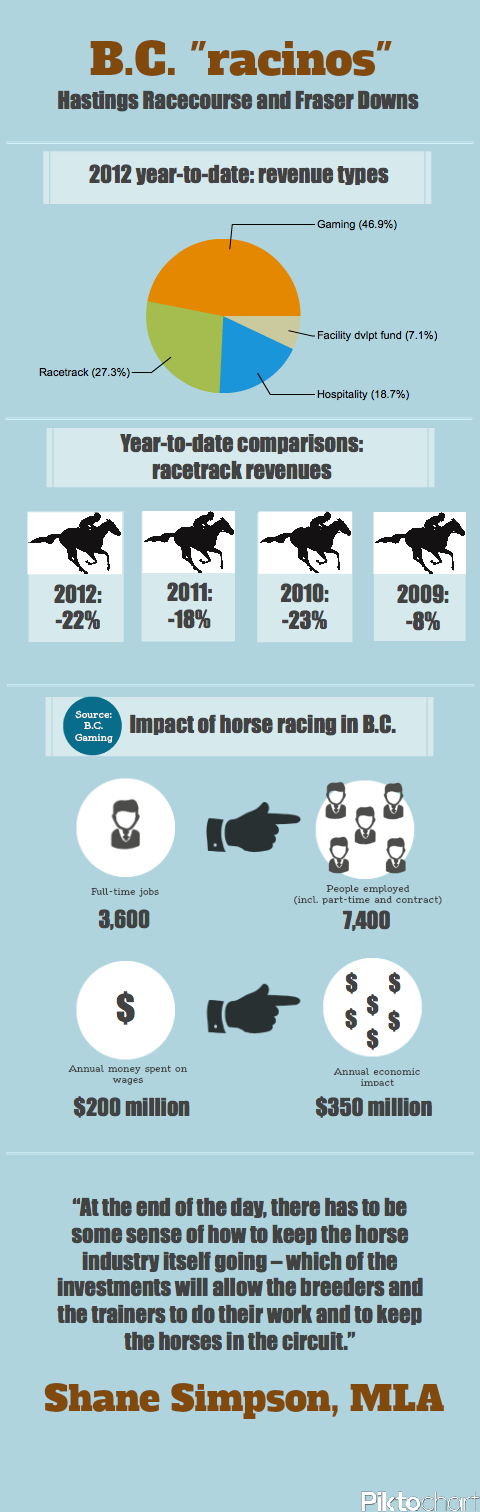
But the most recent report from racecourse owner Great Canadian Gaming shows that track revenues continue to slip. According to its Nov. 7 third-quarter report, racetrack revenues are down $2.5 million, or 22 per cent, from last year at this time. These figures include both of the company’s B.C. racecourses, Hastings Racecourse and Fraser Downs in Surrey.

Those dismal results add more urgency than ever to the company’s and the province’s efforts to figure out what to do about horseracing, an industry that provides 3,600 full-time jobs in B.C., contributes more than $350 million to the province’s economy, and has a long history in Vancouver.

Great Canadian vice-president Howard Blank refused to comment on the financial statement.

Earlier this month, Hastings Racecourse released a press release saying that money spent on wagers had increased five per cent this year.

“Live wagering was up relative to 2011,” said Brian Butters , director of racing sustainability for the BC Horse Racing Industry Management Committee. “Generally speaking, it was a good season.”

But live wagering is only a tiny fraction of overall revenues at Hastings.

Where does the money go?

Of all revenue streams at racecourses, gambling that has nothing to do with horse-racing generates the lion’s share. According to Great Canadian’s report, gambling brings in almost half of the income at its two B.C. racecourses.

The majority of horseracing wagers are for races that are broadcast from around the world.

In 2004, the province and city agreed that Great Canadian could install 600 slot machines at Hastings Racecourse as an effort to support the struggling track. Each year, the province subsidizes the horseracing industry by giving track operators a portion of revenues from the slots.

As for revenues from wagers on actual horseracing, track owners in B.C. make their money in two ways. Three-quarters of betting revenue is from wagers on races that are broadcast from all over the world. Wagers on live races only account for one quarter of all betting revenues.

“Live racing is such a small part of the financial picture,” said Butters. As for wagering on broadcast races, “[it] hasn’t been as strong as it has in the past.”

A struggling industry

Financial struggles in the horseracing industry aren’t new. Over the years, attendance at horseracing events across North America has dropped. In 2009, the province set up the B.C. Horse Racing Industry Revitalization Initiative to find solutions to rejuvenate the ailing sector.

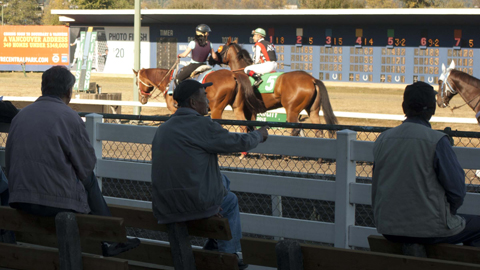
The majority of horseracing wagers are for races that are broadcast from around the world. (Photo: Maryse Zeidler)

“There really are a couple of generations that didn’t take part in horse racing,” said Butters. A big part of the industry’s plan to improve horseracing in B.C. is to attract younger audiences to the sport.

Superstar jockey Mario Gutierrez played a big part in attracting those audiences this summer. Just one win short of the Triple Crown, he drew large crowds and brought worldwide attention to Hastings Racecourse.

But the 2011 Horse Racing Industry Business Plan said that although marketing efforts contributed to increased attendance, “customer retention poses a challenge given that the quality of the food and facilities at Hastings Park are not impressive.”

Gamblers in Metro Vancouver have a number of glamorous new casinos to chose from – the Edgewater Casino, the River Rock, and Grand Villa. By contrast, Hastings Racecourse is an aging facility on Vancouver’s east side.

The horseracing revitalization committee is preparing to release a five-year plan early in the New Year with suggestions on how to rejuvenate the industry.

“At the end of the day,” said Shane Simpson, MLA for the area “there has to be a some sense of how do you keep the horse industry itself going – which of the investments will allow the breeders and the trainers to do their work and to keep the horses in the circuit.”

Artists “pushed out” of building meant to provide a permanent home

The Artist Resource Centre is one of few affordable live-work building for artists in Vancouver. Artists are claiming that expensive rent is squeezing them out of a building meant to provide affordable live-work space in Vancouver.

Originally published in The Thunderbird October 19, 2012

Artists say they’re being squeezed out of a building that was created specially to provide affordable live-work space for artists.

The Artist Resource Centre is one of few affordable live-work building for artists in Vancouver. Artists are claiming that expensive rent is squeezing them out of a building meant to provide affordable live-work space in Vancouver.

The Artist Resource Centre is one of few affordable live-work building for artists in Vancouver. 

That’s something they say demonstrates a flaw in early efforts to create low-cost housing and work space for the city’s arts community  — and that they hope won’t happen again.

Photographer Wendy D lived in the Artist Resource Centre building in Vancouver’s port-area industrial zone for 10 years. Last year, she was forced out because of rising rent, as well as what looked like management’s lack of concern for people trying to run art businesses. In her case, the landlord didn’t fix a broken elevator for weeks — a serious problem for someone in a seventh-floor unit  who sells her art by having clients visit her studio.

She said most of the original group that moved into the 80-unit building in the late ’90s — attracted to one of the few places that allowed artists to both live and do work that is often loud or semi-industrial — left in the last five years as rents began to increase more than in the past.

“They didn’t care about artists any more,” she said, “it was all about the money.”

That’s a disturbing end to what was a laudable effort from the city to find space for artists as they were forced out of downtown warehouses in the post-Expo downtown boom, as city inspectors cracked down on fire and safety hazards in then-derelict buildings.

The ARC is zoned industrial and as a result does not fall under the purview of the B.C. Residential Tenancy Branch, which restricts rent increases for units that are used for residential purposes only.

Vancouver council granted special zoning for the ARC in 1993, as a way to create new affordable artist live-work spaces. The city continues to struggle with that issue.

In June, the city announced it would lease out 26,000 square feet of new creative space on two city-owned properties. The new studios will be rented out at $7.5 to $15 per square foot, but are only intended for work.

Those spaces will likely be managed by a non-profit, which should forestall drastic rent increases. But, says Vision Vancouver Coun. Heather Deal, that doesn’t give the city any power to dictate what happens in the earlier generation of private buildings that got zoning dispensations.

“There are a few different models of live-work and there are limits to how much the city can impose price controls in privately owned buildings,” said Deal. “We have made this a high priority so are working to use all of the limited tools available to us as a municipal government.”

The city tools include operating its own live-work studios, using community amenity contributions from developers to generate new spaces, and using zoning or taxation to encourage the construction of artist spaces.

The ARC, at Commercial Drive and Powell Street, is one the few live-work buildings in Vancouver that allows industrial activity like welding and woodworking, as well as amplified music and dance. It is one of five live-work buildings owned and operated by Reliance Holdings Ltd., which owns and manages a wide variety of commercial and residential properties in the city.

Roy Mackey, a current resident and former manager of the ARC, said when he first moved into the building over 10 years ago, “rents wouldn’t go up until tenants moved out.”

Over the past 10 years, studios similar to the one he first moved into have increased 65 per cent, rising to $1,300 a month from $850. The smallest and most affordable studios in the building now cost $1,000 a month, while some of the larger suites cost around $2,000.

Doris Siu, a staff member in accounts receivable at Reliance Holdings, said the company is “not aware of any prevailing pattern of complaints related to rents,” adding “the building remains full of artists.”

History of live-work studios

The ARC studios are part of almost 1,500 live-work spaces approved at a time when many Vancouver artists were being pushed out of the cheap warehouse spaces because of fire and safety violations. “In the mid ‘80s and early ‘90s, we were all being evicted from our studio spaces,” said Esther Rausenberg, former president of Artists for Creative Spaces, a group that came together to lobby the municipal government in response to the evictions.

The average artist in Vancouver makes $27,000 a year, compared to $36,123 for the average Vancouverite. Affordable housing is usually defined as housing that doesn’t cost more than about a third of household income. For the average artist, that would be $675 a month.

Erica Babins, an ARC resident, shares a studio with a roommate to keep her rent affordable.

Although live-work studios were meant to provide affordable space for artists, they have attracted other residents over the years, according to a University of Toronto report on creative spaces in Vancouver and other cities. As a result, artists say competition from other creative sectors is increasingly squeezing them out of these trendy spaces.

Rausenberg said it tried to work with the city to develop spaces specifically designated for artists, but instead it zoned studios as live-work, without specifying the type of creative work.

‘Economic necessity’

Erica Babins, an ARC resident, shares a studio with a roommate to keep her rent affordable.

Erica Babins, an ARC resident.

Despite the rent increases, many artists still live in the building. Erica Babins, a 22-year-old actor and singer who has been living in the ARC for almost a year, shares a $1,300 open studio apartment with a roommate.

For privacy, the two roommates erected a plywood divider to separate their sleeping areas. Babins said that although she couldn’t afford to live in the space on her own, the arrangement is still cost-effective because her rent gives her access to the building’s shared workshops. “I rehearsed my entire Fringe Festival show here for free.”